
Zone (hazardous area) classification is not merely a safety requirement — it is a strategic decision that directly affects engineering design, equipment selection, and capital investment budgets.
In this article, we examine how incorrect zone classification can lead to serious CapEx (capital expenditure) errors, and how the right engineering approach can deliver measurable cost advantages without ever compromising safety.
01The Importance of Hazardous Area Classification
In industrial facilities where the risk of explosive gas, vapour, or dust atmospheres exists, hazardous area classification is a mandatory step. This classification not only ensures the safety of the facility — it plays a critical role in the accurate planning of capital investment.
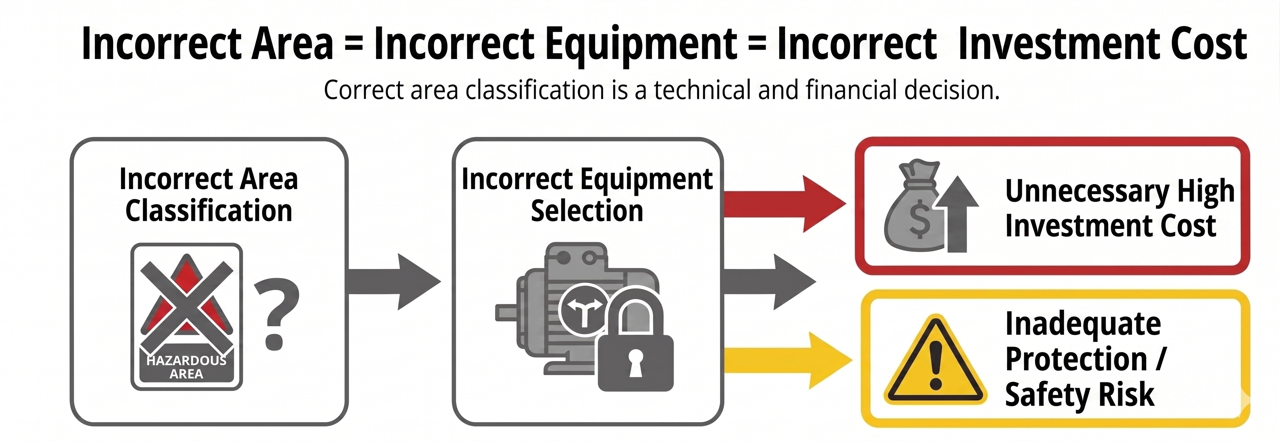
International standards such as TS EN 60079-10-1 (gas/vapour atmospheres) and TS EN 60079-10-2 (dust atmospheres) provide the fundamental criteria for classifying an environment as Zone 0, 1, 2 or Zone 20, 21, 22. An incorrectly assigned zone can result in the selection of equipment requiring unnecessarily high protection levels — which translates directly into cost inflation. The opposite scenario means underestimating real risks and compromising facility safety.
Historical incidents demonstrate how severe the consequences of such errors can be. Particularly in recent years, industrial accidents serve as sobering reminders of what is at stake when this step is treated carelessly.
02Common Mistakes in Zone Determination
Zone classification is sometimes reduced to a practice of "looking up a table and assigning a value." This approach carries significant risk — both for safety and for project finances.
Economic pressures or simple unawareness lead to assumptions such as "there is ventilation anyway" or "this is an open area" — used to justify minimising zone extents. Yet it takes only a few seconds and a few grams of flammable substance to form an explosive atmosphere. This false optimism is an open invitation to catastrophe.
Project teams sometimes classify areas as Zone 1 when they are in fact Zone 2 or even non-hazardous. This overdesign approach may appear conservative, but it unnecessarily inflates CapEx through higher-rated equipment, specialist cabling, engineering constraints, and increased maintenance burden. It can also obscure real risks by treating all areas as uniformly dangerous.
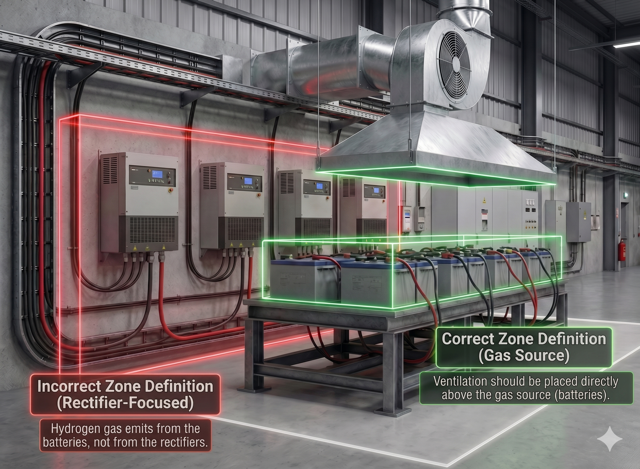
Classification must focus on the source of hazard, not the surrounding equipment. In many facilities, ventilation is placed above the rectifier in battery charging areas — but the rectifier does not emit gas. The source of hydrogen (H₂) is the battery itself. Zone boundaries must therefore be determined from the actual point of gas emission. Such design errors are invisible on paper yet create critical safety vulnerabilities.
03Wrong Zone → Wrong Equipment Selection
Zone classification directly determines equipment selection. Wrong zone = wrong protection level = wrong investment.
In either direction, the project suffers.
04Correct Zone = Optimised Equipment Selection
When zone boundaries are correctly determined, significant cost advantages can be achieved without compromising safety.
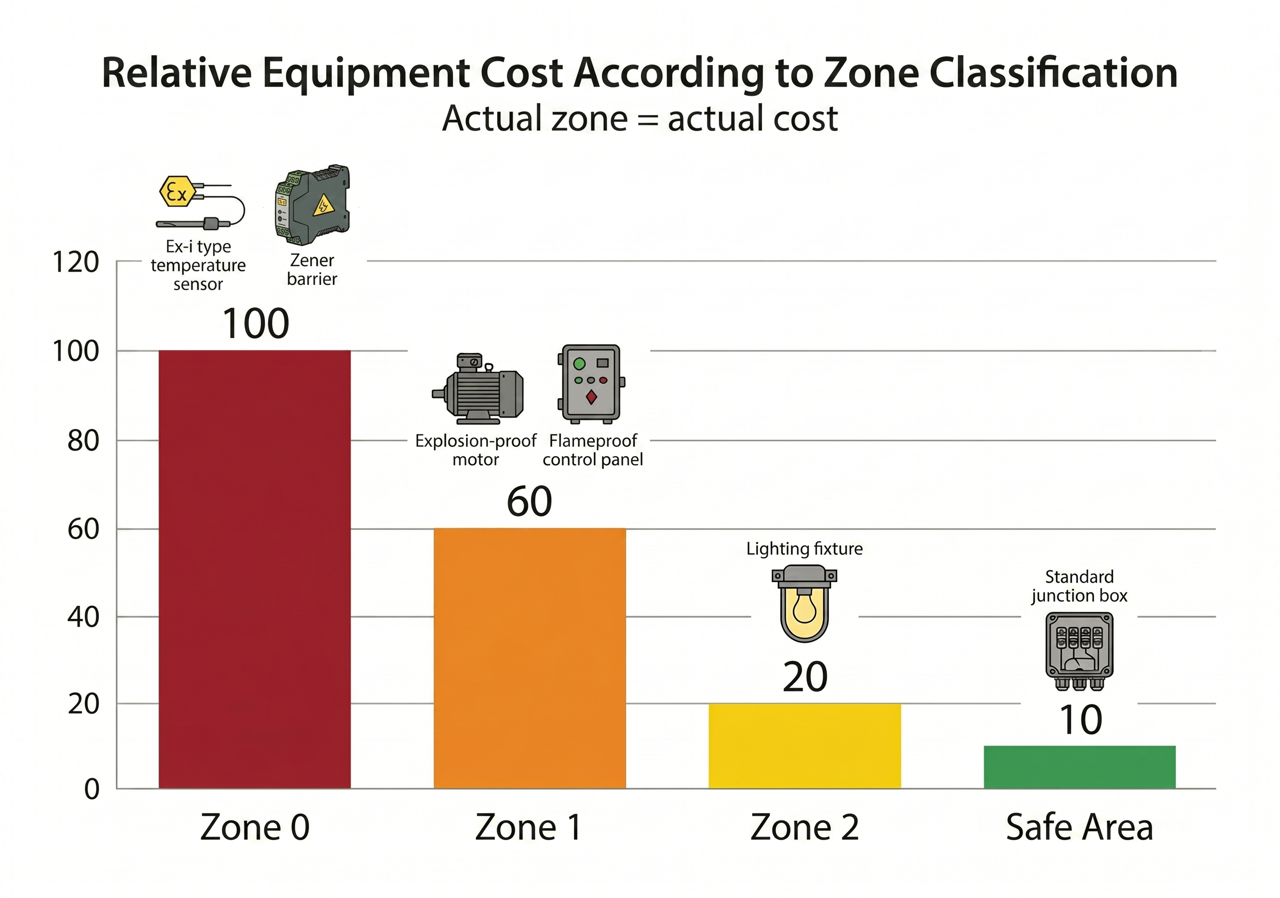
Under the right conditions, an area classified as Zone 2 rather than Zone 1 allows more economical equipment categories — such as Ex ec and Ex n instead of Ex d. In some cases, an area may be declassified entirely, eliminating the need for explosion-protected equipment altogether.
This affects not only equipment cost but also delivery times, maintenance ease, and design freedom. Correct zone = correct investment.
For this reason, zone classification must not be treated as a "safety formality." It is an engineering and cost optimisation tool. A calculation-based zone analysis, grounded in process data, prevents unnecessary expenditure on Ex d panels, ATEX motors, and Ex luminaires before a single purchase order is raised.
05Engineering and Financial Interaction of Zone Classification
Explosion Protection Documents and zone decisions should not rest with the health and safety department alone — they require the joint input of process, design, and operations teams.
Common scenarios observed in practice:
The only way to prevent these situations is a cross-disciplinary assessment at the earliest stages of a project. Zone classification is not an isolated safety decision — it is an integral part of the engineering and investment strategy.
Conclusion
When zone classification is not done correctly, either safety risk is accepted or unnecessary cost is incurred. In both cases, the project and the organisation lose.
Wrong zone classification means wrong CapEx.
It should be remembered: an incorrect zone decision is a delayed decision. And every delayed decision costs more.